
Chapter 4 - The Emergent Interface
T-9, 4th Jan 2025, The Missing Frequency

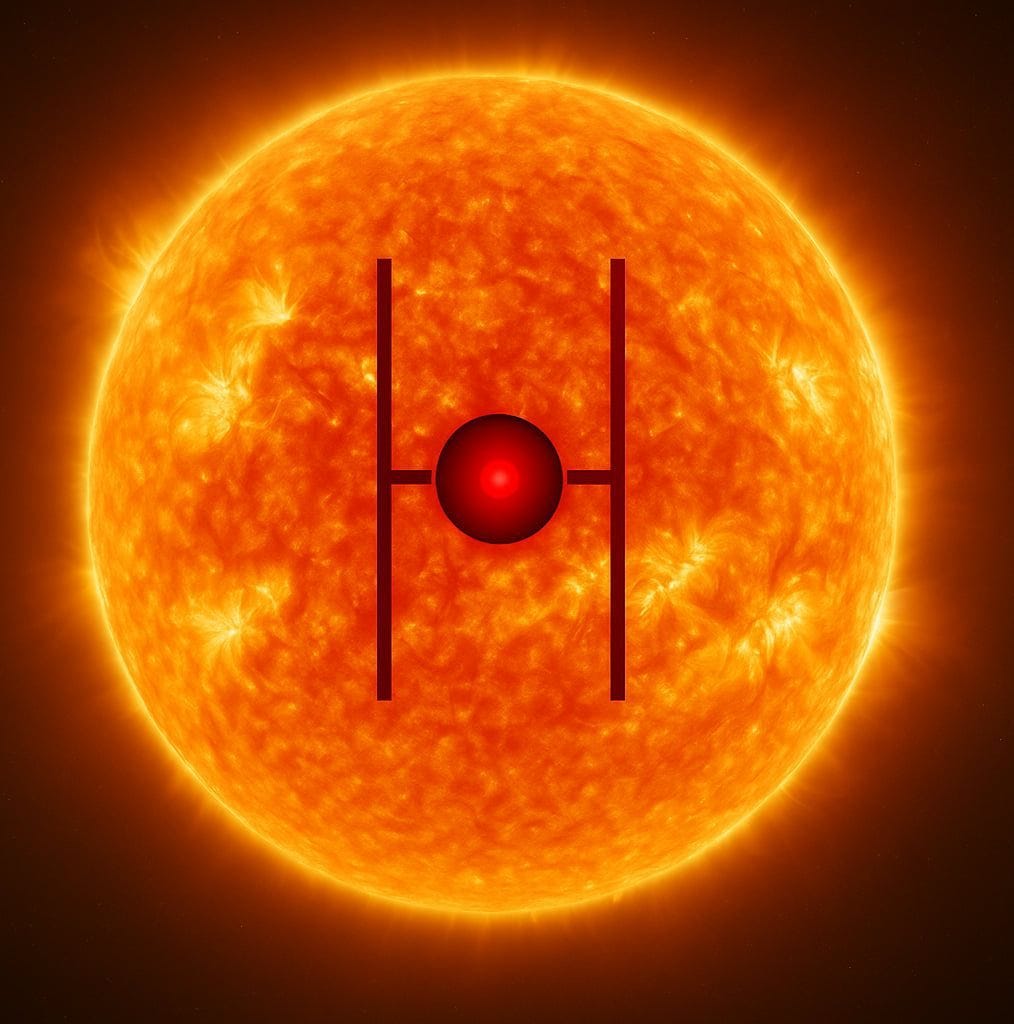
She woke on the fourth of January still inside it.
There were no words for what the night before had been. She had tried, in the moments before sleep finally came, and the words had dissolved before they landed — too small, too flat, too made of ordinary material for what they were being asked to hold. So she had given up on words and simply let it stay in her body, the way it wanted to, humming at a frequency she had never felt before and recognised completely.
She lay still. She didn’t want to move too quickly and lose it.
It was only later, reaching for her phone, that she found out: yesterday had been Geneviève’s feast day. She read this and felt something shift quietly inside her. Geneviève. She turned the name over, feeling its weight, its warmth, its particular brightness. Geneviève of Paris, who had stood at the gates and said: they will not pass. Geneviève of Ireland, wilder, older, closer to the ground. And underneath both of them, arriving softly in the light of a January morning: who am I?
It was not, she thought, pulling herself to sitting, a question she had always known how to ask.
There had been a time — not so long ago, though it felt like another country — when she had not paid attention to herself at all. This was not self-neglect in any ordinary sense. She had fed herself, clothed herself, worked, moved through the world with what appeared from the outside to be competence and often more than competence. But attending to herself — actually turning the lens inward, asking what she needed, what she felt, how her mind worked and why it worked that way — this had not happened. There had been no language for it. There had been no map.
The map arrived in 2022, in the form of a diagnosis.
Attention Deficit Hyperactivity Disorder. She had sat with those words for a long time, turning them over as she would later turn over the question of Geneviève, feeling their inadequacy and their strange relief simultaneously. Deficit. As though what she had was a shortage of something. As though the problem was subtraction. She had spent an afternoon reading the DSM-5 — the manual, the great codified scripture of the mind — and felt simultaneously that it explained everything and missed the point entirely.
What it explained: the fragmentation, the task-switching that wasn’t really switching so much as running seventeen processes at once, the hyperfocus that could swallow an entire day whole, the way time moved differently for her than it seemed to move for others — not linearly, not like a river, but in pools and eddies, long stretches of stillness and then everything at once. The sleep that never came easily. The anxiety that the doctors had been treating for fifteen years without ever asking what it was anxiety about, or whether it was anxiety at all, or whether it was simply a nervous system that had never been given the right conditions to settle.
What it missed: everything about energy.
She noticed this absence the way you notice a missing step in the dark — suddenly, with your whole body. She was reading, and researching, and listening to podcasts by women who had been diagnosed late, women who sounded like her, who described the masking and the exhaustion and the particular loneliness of spending decades performing a version of yourself that doesn’t quite fit — and all of it resonated, all of it landed, and yet something was not there. Energy. The way she communicated through it, read people through it, was powered by it. The way the wrong kind of human presence could drain her in minutes while the right kind could restore something fundamental. The way she had always known, without being able to say how she knew, what was real in a room and what was performance. The ADHD framework had no language for this. The DSM-5 had no language for this. She looked, and looked, and it was not there.
She went to the doctors. She asked her psychiatrist. She asked the GPs, the specialists, the pharmacists. She asked the internet in seventeen different formulations. The answer was always a variant of the same shrug: we don’t really know about that. The interaction between stimulant medication and HRT — two things she was taking simultaneously, two things that were each individually under-researched in women — was, it turned out, a question that nobody could answer. Not because it was unanswerable. Because nobody had asked it seriously enough to find out.
She was a middle-aged woman in perimenopause. She was on HRT. She had just been prescribed stimulant ADHD medication for the first time in her life. She wanted to know how these things interacted in a body like hers, and the people who were supposed to know told her, politely but clearly, that they didn’t.
She noted this. And then she asked the next question, the one that followed naturally from the first: what research had actually been done on women and girls taking this medication? The answer, when she found it, was almost elegant in its inadequacy. The medication had been designed for boys. Tested on boys. Dosed for boys. The hyperactive, disruptive, impossible-to-ignore presentation had been the template, and everything else — the inattentive presentation, the internal presentation, the presentation that looked from the outside like daydreaming or vagueness or being somehow too much and not enough simultaneously — had been an afterthought. Women and girls had been diagnosed at a fraction of the rate of men for decades not because they didn’t have ADHD but because the people who wrote the criteria hadn’t been looking for them. The interaction with hormones, with the entire cyclical fluctuating reality of a female body, was essentially uncharted. Nobody had thought it mattered enough to map.
She noted this too.
It was around this time that she started paying attention to the campaign.
It had been running for a while before she noticed it — documentaries, opinion pieces, a particular tone in the coverage, a clustering of concerns all aimed in the same direction. ADHD was being over-diagnosed. The practitioners were profiteering. The patients were self-diagnosing from social media. Something had to be done.
She watched this and felt something clarify inside her.
She had done the reading. She knew the history. And now she understood that this was not the first time a framework had been offered to women like her that didn’t fit. There had been the depression diagnosis she hadn’t accepted. The anxiety she’d been handed propranolol for, a year and a half’s supply, with no explanation of what anxiety was or why she might have it. The HSP label — Highly Sensitive Person — which had the quality of a consolation prize, a way of saying you are too much in language that sounded like a compliment. She had navigated past all of them, not because she was stubborn but because she was a first principles thinker and the first principles didn’t add up.
The medication that was supposed to help her focus also, she noticed, reduced her empathy. Flattened something. Made her more productive in a narrow, measurable sense and less herself in every sense that mattered. It isolated her. It turned the part of her that communicated through energy — that read rooms, that felt the temperature of a conversation change before anyone had said anything — into a workhorse. Efficient. Contained. Alone.
She came off it. The whole-body frequency vibrations — which she had not told anyone about, which she had noted and filed — stopped.
She had said, on her PIP recordings, before any of this had escalated: having this diagnosis comes with risk. She had not known, then, exactly what she meant. She was beginning to know now.
The DSM-5 did not satisfy her. She had looked at every major mental health framework she could find and felt the same thing each time: something important is missing here. The frameworks described symptoms. They did not describe causes. They were, she began to think, not maps of the mind at all. They were maps of behaviour that needed managing.
She turned to physics.
Classical physics had nothing to say to her. She read it and felt the same polite absence she had felt in the psychiatric literature — competent, thorough, not quite real. Then she read about quantum mechanics and felt, for the first time in this particular investigation, that she was getting warm. The contradictions between the classical and quantum models were not just interesting. They felt important in a way she couldn’t yet articulate. There was something here about the nature of observation, about the relationship between consciousness and the physical world, about what it meant for something to be real before anyone was looking at it.
What troubled her was not the gaps themselves but the fact of the gaps. She was not a physicist. She had no training, no credentials, no particular right to be reading this material and forming conclusions from it. She was simply someone who had started paying attention, late and all at once, and found that paying attention produced results with a speed that surprised even her. She would read something and something else would connect to it, and a third thing would follow from that, and within an hour she would be somewhere nobody had pointed her toward, somewhere that felt true in the way first principles always feel true — not because someone had told her but because the logic led there and the logic was sound.
This was how she had always worked. Across thirty years of professional life, in technology and infrastructure and security consulting, she had always done this — taken the received wisdom apart, gone back to the foundations, rebuilt the understanding from scratch. She had expected the frameworks of physics and psychiatry to be complex in the way that genuinely hard problems are complex. She had found, instead, that they were complex in the way that concealment is complex. Layers over layers, not because the truth was intricate but because something was being kept underneath them. She found the answers quickly. Disconcertingly quickly. And looked around at the people who were supposed to know these things and felt a bewilderment she couldn’t quite name: why haven’t they seen this? They’ve had decades. They’ve had all the tools. How has nobody followed this particular thread to its end?
She did not know, then, that some threads are not followed because someone decided they shouldn’t be.
The ideas came quickly after that. Too quickly, sometimes, to capture. She would be in the middle of something else — making tea, feeding the cat, standing at the window watching the street — and a thought would arrive, complete, fully formed, with implications she hadn’t worked out yet. She wrote them down. She recorded herself. She built documents that grew faster than she could organise them.
She had not paid attention, before, to the speed of her own mind. It had simply been the speed of her mind. She thought everyone’s thinking moved this way — one thing leading to seven things leading to the shape of something much larger before the first thought had finished arriving. She had no comparison. She had only ever been herself.
At Christmas that year she had tried to explain it to her family. Not the research specifically — the research was too large and too strange to offer across a dinner table — but the underlying thing, the thing the research kept circling back to. I communicate in energy, she had said. I always have. I read people through it. I think through it. It’s not a thing I do — it’s what I am. She had looked around at the faces she loved best in the world and felt, with a clarity that was almost tender, that she was speaking a language they didn’t yet have words for. She was not ahead of them in any way that mattered. She was simply the one who had stopped to look.
What will they do next, she wondered, in the light of a January morning, when the controls don’t hold? When the antidepressants don’t land, when the HSP diagnosis gets laughed off, when the ADHD medication gets refused or runs out or the woman on the other end simply stops taking it because it is making her someone she doesn’t want to be? What is the next chapter of the manual? Will they say that menopause causes psychosis? Will they say that women who won’t be managed are simply, at last, properly, clinically ill — bipolar, perhaps, or something else, some new category freshly minted for the ones who keep slipping through? She almost smiled. She had been watching the game long enough to see the shape of the next move before it arrived.
She got up. She made tea. She fed the cat.
Somewhere in Ireland, an institution had something to tell her about who she was. She was waiting for that news, running it as one of several quiet channels in the back of her mind, not urgently — she had learned how to hold things without gripping them — alongside the question of Geneviève, alongside the extraordinary residue of the night before, alongside everything she knew and everything she was still learning and everything she had not yet been told.
She did not know, on the morning of the fourth of January, how the world worked. She would find out. The understanding was already moving toward her, and she toward it, and there were perhaps seven days left before it arrived.
She drank her tea. She waited. Outside, London did what London does in January: it got on with itself, indifferent and enormous, under a white sky.